Topo Flow Limits
Identifiability limits for latent higher-order network structure from edge-flow observations.
Research question
Algorithms can estimate filled triangles from edge flows, but an estimate does not establish whether the latent higher-order structure is identifiable in the first place. This project studies that prerequisite: what can be recovered, under which excitation model, and with how many observations?
Approach
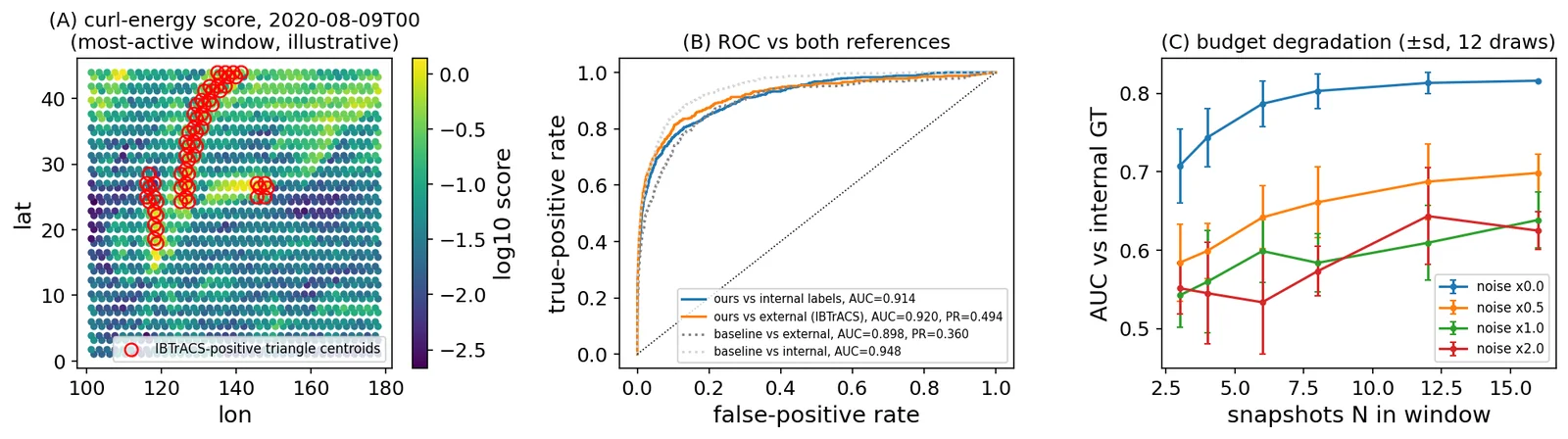
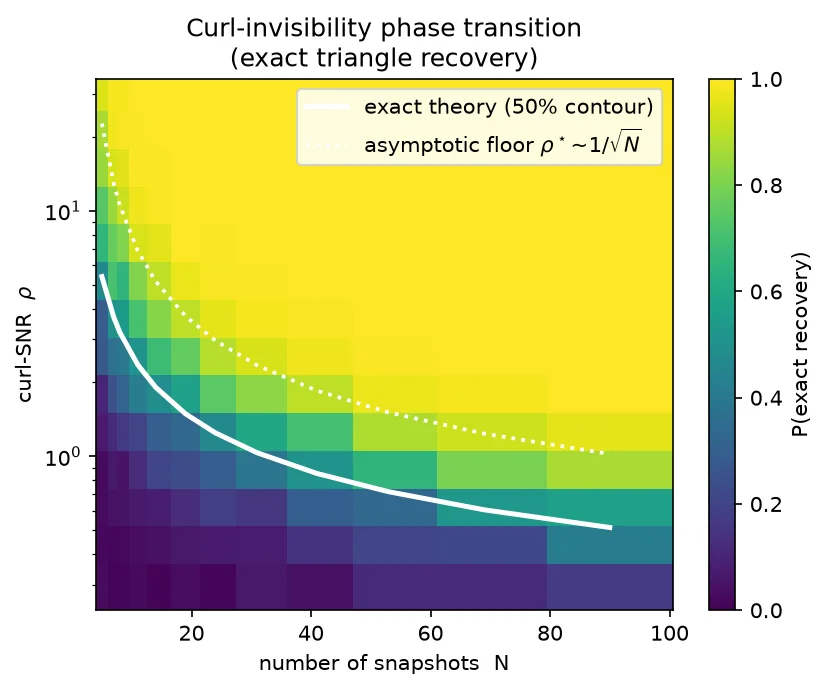
The repository uses Hodge decomposition and covariance models to distinguish excitation regimes, develops finite-sample limits, implements a lifted-covariance estimator, and connects analytical claims to CPU Monte Carlo tests. A real-data study uses the same curl statistic to localize vortices in ERA5 data against independent references.
Evidence and boundaries
The public record includes theorem-linked tests, simulated recovery contours, and the ERA5 experiment. These are repository-reported results from active research, not an accepted or published paper. The real-data experiment is framed as vortex localization, not recovery of physical topology. Each identifiability result depends on the excitation assumptions stated in the manuscript and code.
Artifacts and provenance
- Source code
- Repository manuscript — research manuscript; no publication claim
- Cyclone figure source
- Phase-transition figure source
- Code and repository figures are distributed under the repository’s MIT license.