PISA — accepted upstream contribution
A merged type-safety refactor in PISA, with the high-performance retrieval architecture, maintainer guidance, and contribution evidence documented.
Accepted contribution and guidance
I contributed to the PISA upstream search engine through pull request #641. The patch replaced a boolean representing whether a query algorithm requires WAND data with the scoped enum WandDataRequired::{Yes, No}. It updated the command-line mapping, requirement checks, and tests without changing runtime behavior, making the interface harder to misuse and its call sites self-documenting.
The work implemented maintainer Michał Siedlaczek’s issue #634. He confirmed the scoped Yes/No naming, reviewed the pre-merge verification record, and merged the tested patch as upstream commit ae8cc33. This is maintainer-guided open-source work, not academic supervision.
What PISA does
PISA is a high-performance C++ platform for indexing large text collections, executing search algorithms, and running information-retrieval experiments. It supports multiple compressed-index formats, document reordering and sharding, WAND statistics, several query-processing strategies, and research-oriented command-line tools.
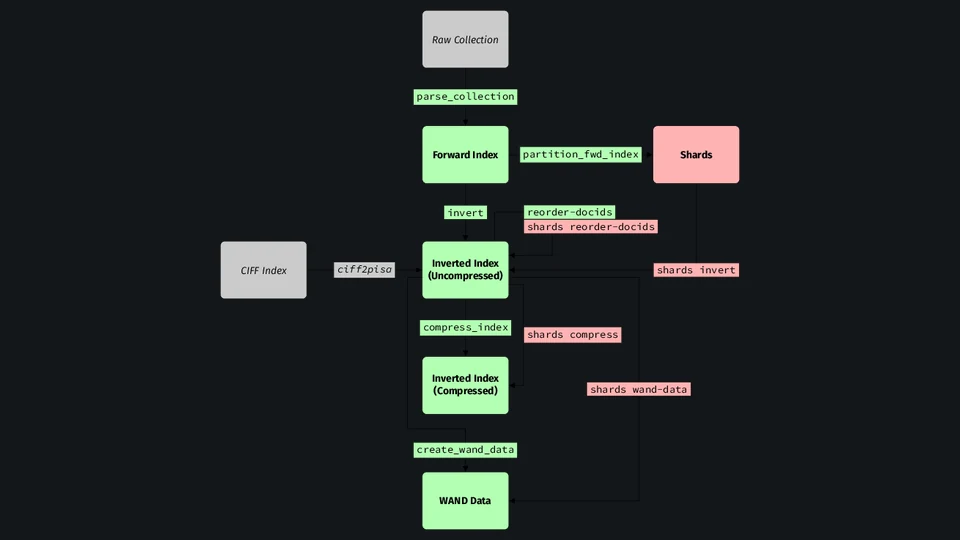
Principle and architecture
The indexing pipeline parses a raw collection into a forward index that preserves per-document token order, inverts it into term-to-document posting lists, and can reorder or shard document identifiers. A selected codec compresses the inverted index; an additional pass builds WAND statistics used for dynamic pruning. Query processors combine the index with a scorer and an algorithm such as exhaustive retrieval, WAND, or block-max WAND, then return stable top-k results. The contributed enum makes each algorithm’s WAND-data requirement explicit at this architectural boundary.
Evidence and attribution
- My public fork
- Upstream PISA repository
- Maintainer-filed issue #634
- Maintainer naming confirmation
- Merged pull request #641
- Pre-merge verification record
- Merged upstream commit
- Commit-pinned project overview
- Commit-pinned indexing-pipeline guide
- Commit-pinned cover source
My catalog entry remains a fork because its default branch contains no commits ahead of upstream. The accepted authorship evidence is the upstream PR and merged commit.